
Quick Answer
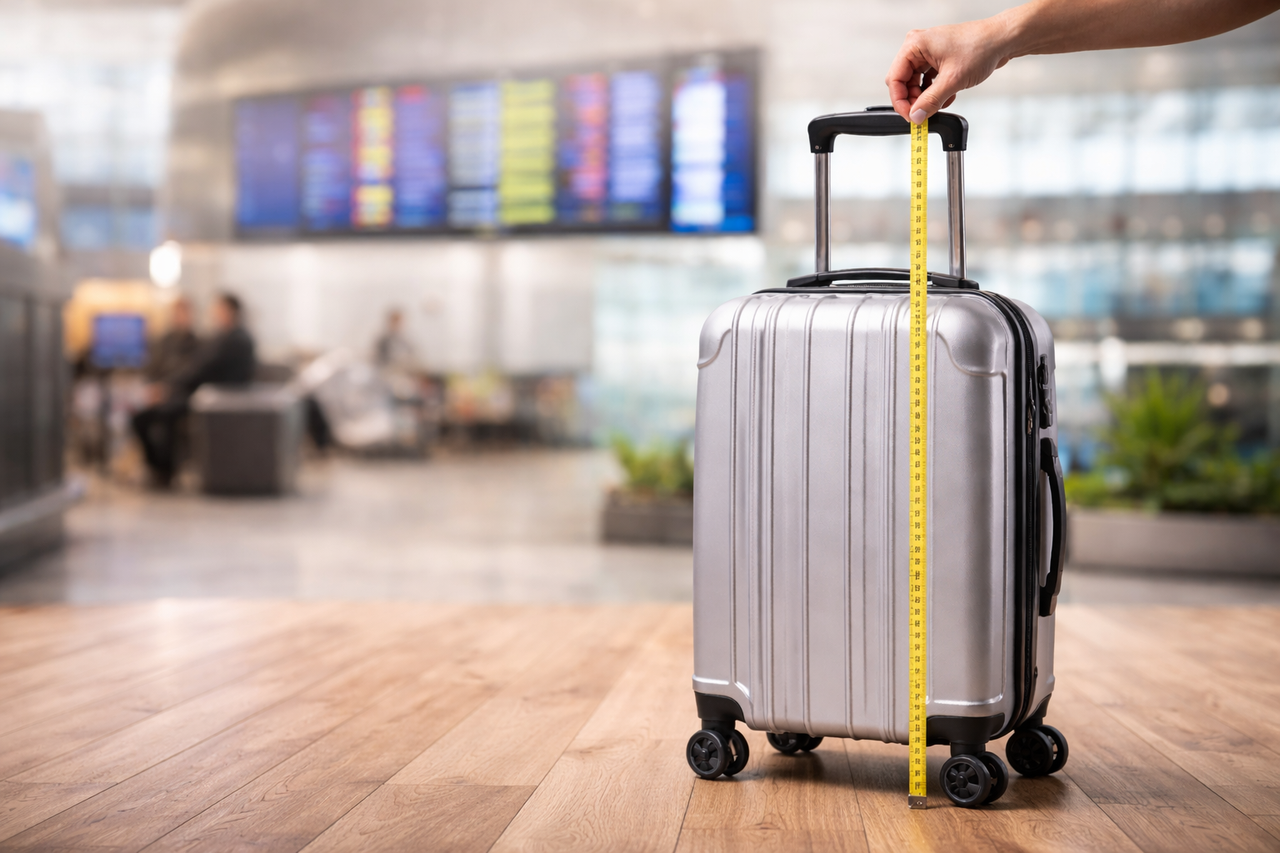
To measure your carry-on luggage correctly, measure the external dimensions of your fully packed bag — including wheels, handles, side pockets, and any protruding parts. Most airlines allow around 22 x 14 x 9 inches (56 x 36 x 23 cm), but limits vary by airline, aircraft type, and route. Always compare your measurements against your specific airline’s policy before flying.
- Key takeaway: Measure the bag fully packed.
- Key takeaway: Include wheels and handles.
- Key takeaway: Check both inches and centimeters.
Definitions
Decision Framework
- If your bag is advertised as “cabin size” → Still measure it yourself.
- If you fly low-cost carriers → Expect stricter enforcement.
- If your bag has spinner wheels → Double-check total height.
- If your itinerary includes multiple airlines → Follow the strictest one.
How To Measure Carry-On Luggage
- Pack your bag exactly as you would for travel.
- Place it upright on a flat surface against a wall.
- Measure height from floor to the highest point (including wheels and handles).
- Measure width at the widest point.
- Measure depth including side pockets or expansion.
- Add dimensions to check linear size if required.
Before You Fly Checklist
- □ Confirm airline size limits.
- □ Convert cm ↔ inches if needed.
- □ Weigh bag if airline has cabin weight limit.
- □ Test-fit items to avoid expansion overflow.
- □ Use the Baggage Comparison Tool to check your specific route.
Carry-On Size Limits at a Glance
For exact dimensions and weight for your airline, check:
- Iberia baggage policy (Compare other airlines)
- Vueling baggage rules (Compare other airlines)
- Singapore Airlines allowance (Compare other airlines)
Recommended Tools for Accurate Measuring
Recommended Products
Budget Pick: Etekcity Digital Luggage Scale — lightweight, compact, and ideal for quick pre-flight checks.
Premium Pick: Dr.meter Digital Luggage Scale — higher precision sensor and durable strap for frequent travelers.
Even for carry-on luggage, many international airlines enforce cabin weight limits (often 7–10 kg / 15–22 lb). A small scale can prevent forced gate check.
Common Mistakes
- Measuring the interior instead of exterior dimensions.
- Ignoring wheels and handles.
- Not measuring fully packed size.
- Forgetting expansion zippers add depth.
- Assuming “cabin approved” guarantees compliance.
FAQ
Do wheels count when measuring carry-on?
Yes. Airlines measure total external dimensions including wheels and handles.
Is 22 x 14 x 9 inches always allowed?
No. Many airlines use this as a guideline, but some low-cost carriers have stricter limits.
How do I convert cm to inches?
1 inch = 2.54 cm. You can also use our Size & Weight Converter for quick calculations.
What happens if my carry-on is slightly too big?
You may be required to gate check the bag and pay a fee, especially on strict carriers.
Update Note
Last reviewed and updated: 2026-02-12. Always confirm airline policies before departure, as enforcement may vary by route and aircraft type.