
Quick Answer
Low-cost airlines enforce carry-on size more strictly because baggage fees are a core revenue stream, not a minor add-on. Strict measurement also protects fast turnaround times at the gate. To avoid expensive gate fees, measure your bag including wheels and handles, confirm limits in both inches and centimeters, and compare your airline’s policy before you fly.
- Key takeaway: Budget carriers rely heavily on baggage fees — enforcement is part of the pricing model.
- Key takeaway: A bag that “usually fits” on legacy airlines can trigger a fee on low-cost carriers.
Definitions
Why Enforcement Is Stricter on Low-Cost Airlines
1) Baggage fees are built into the business model
Many low-cost airlines separate the ticket price from optional services. That means cabin baggage is often monetized as an add-on, not included by default. Strict enforcement reduces “free riding” (bringing a bag bigger than the fare permits) and protects the airline’s pricing structure.
- Oversized bags create additional revenue (or force passengers into the paid tier).
- Prepaid bags reduce gate conflicts and speed boarding.
- Clear enforcement makes costs more predictable for the airline.
2) Fast turnarounds depend on smooth boarding
Low-cost carriers schedule tight aircraft turnarounds. Gate delays ripple through the day. Oversized carry-ons slow boarding because they trigger re-packing, bin disputes, and last-minute gate-checking. Strict sizing is a practical way to reduce these slowdowns.
3) Consistency across airports reduces discretion and arguments
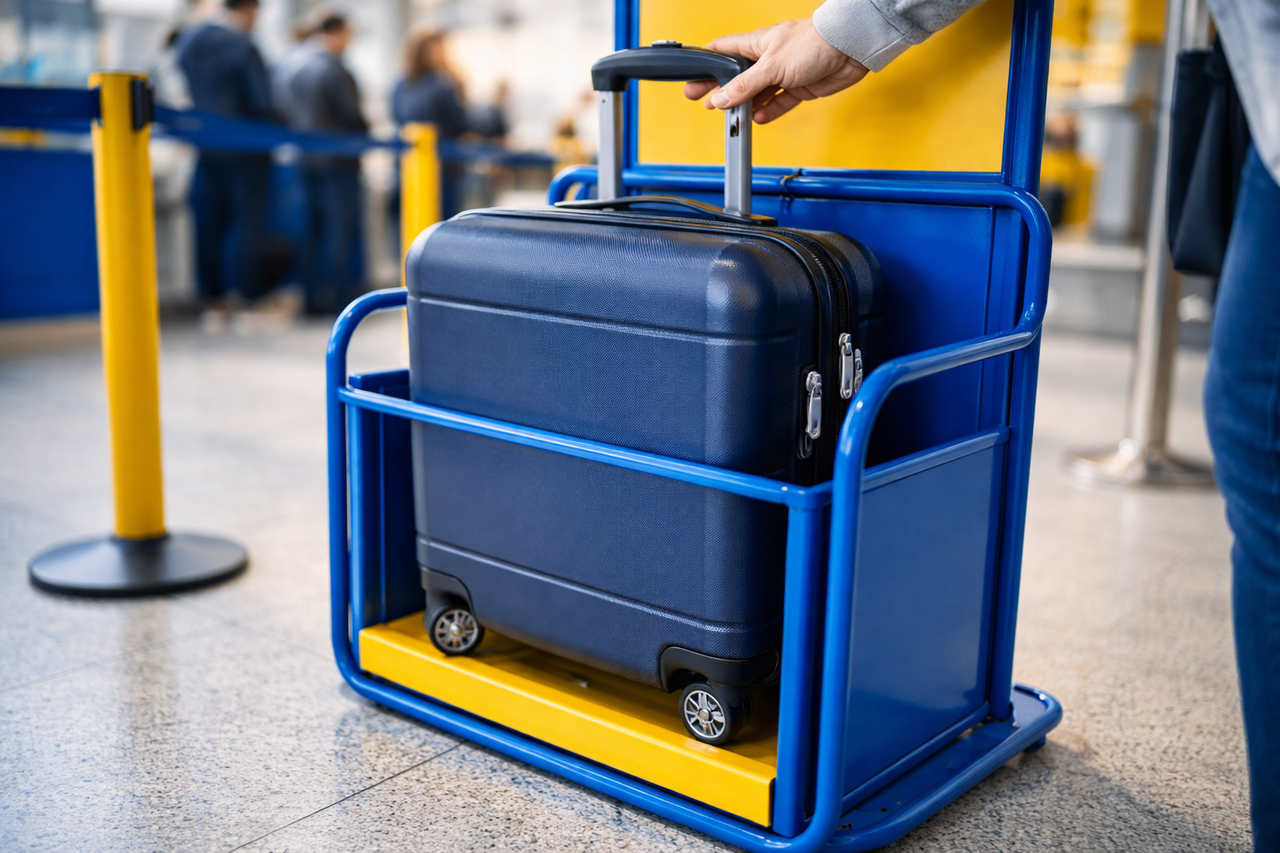
Some legacy carriers apply more discretion depending on route load or staff. Low-cost carriers often standardize enforcement to reduce inconsistency and avoid “why did you allow it last time?” disputes. That’s why you’ll commonly see sizers placed prominently near gates and staff checking bags more actively.
Typical Size Differences (Metric & Imperial)
Exact dimensions vary by airline, fare, route, and aircraft. Use this table as a mental model (not a promise) and confirm your airline’s exact rules before departure.
Want the exact limits for your flight and a “best bag match” recommendation? Use the LuggaGenius homepage bag matching tool (search + comparison experience).
Decision Framework
Use this before you fly to predict whether you’re at risk of a gate fee.
- If your bag is close to the max limit, then measure precisely including wheels and handles.
- If you’re flying a low-cost airline, then assume strict enforcement and avoid “maybe it fits.”
- If you have connections (especially mixed airlines), then check the strictest airline on the itinerary.
- If your bag is expandable, then measure it fully packed (expanded if you might use it).
- If you bought a basic/lowest fare, then confirm whether carry-on is included or requires purchase.
How To: Measure your carry-on correctly (in inches and cm)
- Pack your bag as you would travel (including bulky items).
- Place it upright on a flat surface.
- Measure height from the floor to the top (include wheels).
- Measure width and depth including handles, side pockets, and hard edges.
- Record both units: inches and centimeters (use a converter if needed).
Quick checklist
- □ Measure height/width/depth including wheels & handles
- □ Confirm limits in inches and centimeters
- □ Check carry-on weight rules if your airline has them
- □ If close to limit, plan for a smaller bag to avoid gate fees
Recommended Products
These are practical picks for low-cost airline compliance. Choose based on how strict your typical carriers are and how often you fly.
- Budget Pick: American Tourister cabin luggage — dependable value, common cabin sizing options.
- Premium Pick: TUMI carry-on — precise build, durable materials, smooth rolling for tight gates.
If you’re deciding between models, use the LuggaGenius homepage bag matching tool to compare airlines and find the safest fit for your route.
What Varies by Airline
Even within “low-cost” airlines, rules vary by fare type, route, aircraft, and airport. Some carriers allow a larger personal item, while others enforce a smaller under-seat maximum. Always confirm exact limits before you travel.
- Some fares include a personal item only; carry-on is paid.
- Some airlines enforce carry-on weight limits (commonly around 7–10 kg / 15–22 lb), while others focus more on size.
- Some airports and agents enforce more aggressively, especially during peak boarding.
Use LuggaGenius to compare policies across airlines for your itinerary (and see the best bag match): Compare other airlines.
Low-Cost vs Flag Carrier Comparison
Common Mistakes
- Measuring the bag empty (it expands when packed).
- Ignoring wheels, handles, and exterior pockets.
- Assuming last trip’s enforcement equals today’s enforcement.
- Flying mixed airlines without checking the strictest carrier’s limit.
- Waiting until the gate to “see if it passes.”
FAQ
Are low-cost airlines really stricter, or is it just bad luck?
It’s usually structural, not luck. When baggage fees are a major part of revenue and aircraft schedules are tight, strict enforcement becomes the default. Still, intensity can vary by airport and flight load.
Do wheels and handles count toward carry-on size?
Yes. Airlines measure total external dimensions. If your bag is close to the limit, wheels and handles are often what push it over.
Can I pay at the gate if my bag fails the sizer?
Usually yes, but that’s typically the most expensive option. If you’re at risk, it’s safer to pre-purchase the correct allowance or use a smaller bag.
Do low-cost airlines have carry-on weight limits?
Some do, some don’t. Where weight limits exist, they’re commonly around 7–10 kg (15–22 lb), but this varies by airline and route. Weighing at home is the safest approach.
What if I think I was incorrectly charged?
Document everything: photos of the bag in/near the sizer, your receipt, and the policy page you relied on. If your situation escalates into a claim scenario (especially in the EU for disruptions/denied boarding), services like Flightright can help assess eligibility.
Update Note
Last reviewed and updated: 2026-02-14. Airline enforcement and fare inclusions can change; always confirm your exact allowance before departure.