Liquids Rule Explained (3-1-1): Carry-On Limits, Aerosols, and International Differences
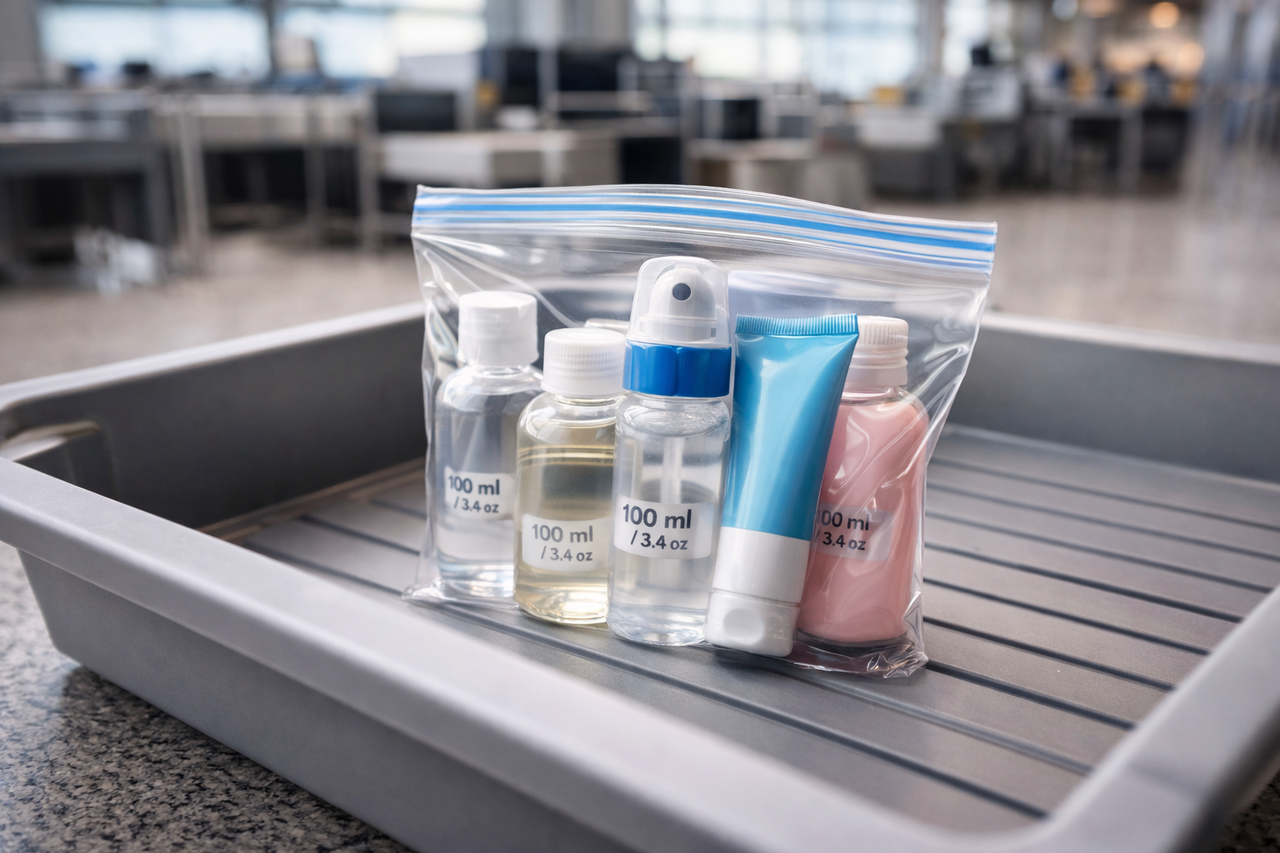
The liquids rule is one of the most common reasons travelers get stopped at security. If you want the fast version: most airports apply a “small containers in a clear bag” approach for carry-on liquids (typically 3.4 oz / 100 ml per container). The details vary by country and sometimes by airport—so the safest strategy is to pack for the strictest version of the rule.
Quick Answer
You can bring liquids, gels, creams, pastes, and many aerosols in your carry-on if each container is 3.4 oz (100 ml) or less and everything fits in one clear bag per passenger. Bigger containers usually must go in checked baggage (unless they qualify as medical/baby exceptions). When in doubt, pack “security-first,” then use LuggaGenius to verify airline baggage rules for your flight.
- Key takeaway: The container size matters, not how much is left inside. A half-full 200 ml bottle still fails.
- Key takeaway: Pack liquids at the top of your carry-on so you can pull the bag quickly without unpacking everything.
Useful next steps: Use the LuggaGenius home search tool (best UX for matching your flight + bag), and run the Packing Checklist before your trip.
Definitions
Decision Framework
Use this quick flow to decide what goes where:
- Is it a liquid/gel/cream/paste/spray? If yes → treat it as a liquid for security.
- Is the container ≤ 3.4 oz (100 ml)? If yes → eligible for carry-on (subject to bag rules).
- Does it fit in your one clear liquids bag? If no → move extras to checked baggage or reduce items.
- Is it medical/baby essential? If yes → keep it accessible and declare it at screening if asked.
- Is it duty-free? Keep it sealed and protect the receipt for connections.
Pre-Security Checklist
- □ Put liquids in a clear, resealable bag (zip closure helps).
- □ Keep each container at 3.4 oz / 100 ml or less.
- □ Pack the liquids bag at the top of your carry-on for fast access.
- □ Avoid “maybe liquids” (spreads, gels) unless you’re sure they fit and comply.
- □ If you’re connecting internationally, pack for the strictest checkpoint on the trip.
Examples: What Usually Counts as a “Liquid”
International Differences
The liquids rule is typically driven by security authorities (country/airport), not by the airline. Airlines can still create friction by enforcing carry-on size/weight, but the liquids screening is usually a checkpoint rule.
What usually stays the same
- Small containers are easier to pass than large ones.
- Clear bag presentation reduces delays and secondary screening.
- Security staff may treat “spreadables” as liquids even when travelers don’t.
What can vary (and why you should pack for strict rules)
- Bag size requirement: some places emphasize quart-size style bags; others use a 1-liter style bag concept.
- Whether you must remove the bag: some checkpoints want it out; others keep it inside if scanners allow.
- Duty-free on connections: some transfer routes are stricter and may re-screen liquids more aggressively.
- Scanner technology: a few airports have upgraded scanners that can change procedures—but don’t rely on that.
To avoid surprises, use: Baggage Allowance Tool (to compare airline baggage rules) and the Packing Checklist (to prepare fast).
What Varies by Airline
Airlines don’t usually set the liquids screening rule—but they do impact your experience: cabin bag weight limits, strictness at the gate, and whether you’ll be forced to check a bag (which changes what you can pack where).
- Use the flight comparison flow on the LuggaGenius home search tool to see allowance rules for your exact airline + fare + route (and match a bag).
- If you’re worried about getting gate-checked, read: What happens if your carry-on is too big at the gate?
- If you’re maximizing cabin space, read: Purse/handbag + personal item rules
Low-Cost vs Flag Carrier: What changes for liquids (indirectly)
Common Mistakes
- Bringing a large container that’s not full (container size is what matters).
- Forgetting that aerosols count as liquids at screening.
- Using a non-clear pouch and hoping it “looks fine.”
- Packing liquids deep inside the bag (causes delays and messy unpacking).
- Assuming duty-free liquids always pass transfers without re-screening.
- Overpacking “maybe liquids” (spreads/creams) that trigger secondary screening.
FAQ
Do liquids still need a clear plastic bag?
In many airports, yes. Even where scanners are better, staff may still ask you to present liquids clearly. Pack a clear bag anyway—it’s the lowest-effort way to reduce friction.
How many 3.4 oz (100 ml) bottles can I take?
As many as fit comfortably in your one clear liquids bag. If the bag won’t close easily, treat it as “too many” and move extras to checked baggage or remove non-essentials.
Do aerosols count as liquids?
Yes—most sprays are treated as liquids at screening. Keep them under 3.4 oz (100 ml) in your clear bag and avoid anything that is obviously hazardous or highly flammable.
Is toothpaste considered a liquid?
Typically yes (gel/paste). Use a travel-size tube (≤ 3.4 oz / 100 ml) and pack it in your liquids bag.
Are duty-free liquids allowed in carry-on?
Usually yes if bought after security and sealed properly, but connections can complicate things. Keep the item sealed, keep the receipt, and avoid opening it mid-trip.
Can I bring baby formula or breast milk over 3.4 oz (100 ml)?
Many airports treat baby essentials as exceptions, but procedures vary. Keep them accessible and be ready to explain what it is. If you’re traveling with a baby, consider reading a dedicated baby baggage guide.
What if I forget and show up with non-compliant liquids?
You may need to discard items, move them to checked baggage (if available), or step aside to repack. The fastest prevention is a quick pre-flight check using a packing checklist.
Update Note
Last reviewed and updated: 2026-02-13
Affiliate note: This guide does not include affiliate picks because the current active partners you shared focus on luggage, scales, eSIM, transfers, airlines, and tracking tags—none of which are the right match for “liquids bag / toiletry bottle” recommendations. If you add toiletry-bottle or travel-container affiliates later, this guide can include a proper Budget vs Premium section without forcing irrelevant products.